PA Checker Tool
Check your website’s Page Authority and review SEO metrics using our external PA Checker tool.
Check Page Authority Opens the external DAPA Checker website.Page Authority (PA) is an SEO metric used to estimate how well a specific webpage may perform in search engine results. A PA Checker helps website owners, bloggers, SEO professionals, and digital marketers review page level authority scores and better understand their website’s SEO profile. By checking Page Authority regularly, users can monitor changes and identify areas where their SEO strategy may need improvement.
Our PA Checker is designed to make page authority analysis simple and accessible. Enter a webpage URL into the available checker field and use the tool to review the result, depending on the data supported by the checker. This information can help you evaluate individual pages, compare URLs, and plan practical improvements to your website.
What Is Page Authority (PA)?
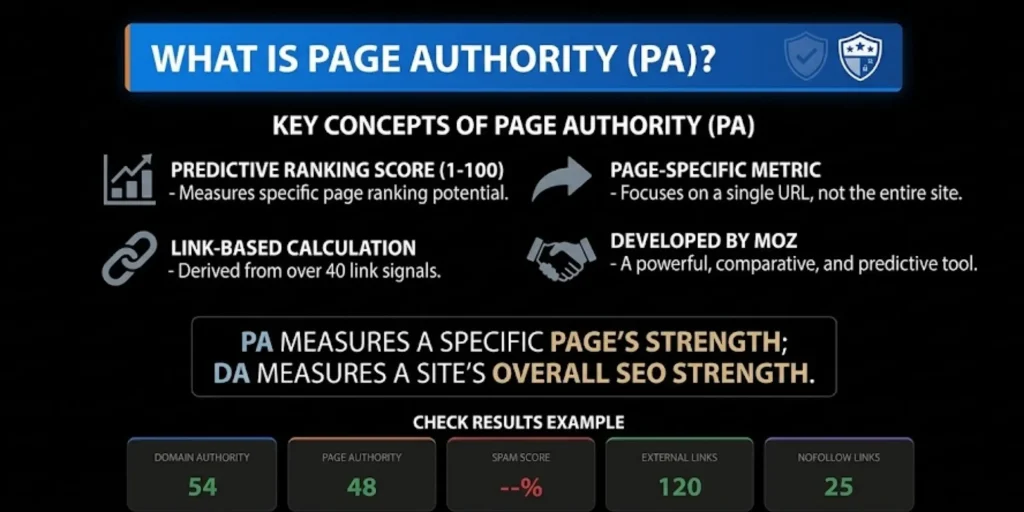
Page Authority is a predictive SEO metric developed by Moz to estimate the ranking potential of an individual webpage. It uses a logarithmic scale from 1 to 100, with higher scores generally indicating stronger predicted ranking potential. However, PA is not a Google ranking factor and does not guarantee a particular position in search results.
Page Authority differs from Domain Authority (DA). PA focuses on an individual webpage, while DA estimates the ranking potential of an entire domain. Both metrics can help with SEO analysis, but they should be used as comparative indicators rather than direct measures of Google rankings.
How to Use the PA Checker
Checking Page Authority is straightforward. Follow these steps to analyze a webpage:
- Open the PA Checker tool on our website.
- Enter the complete URL of the webpage you want to analyze.
- Click the check button to submit the URL.
- Wait for the tool to process your request.
- Review the displayed PA score or available analysis results.
For more useful comparisons, check several relevant pages and review their scores alongside other SEO indicators, such as backlinks, content quality, and internal linking.
Why Is Page Authority Important for SEO?
Page Authority can provide an additional perspective when evaluating the strength of individual webpages. It may help SEO professionals compare competing pages, review link-building progress, and identify URLs that need further optimization.
A page with a higher PA score may have a stronger backlink profile than a comparable page with a lower score. However, content relevance, search intent, technical performance, and many other factors also influence search visibility. Therefore, you should never rely on PA alone when making SEO decisions.
Key Features of Our PA Checker
- Simple URL Analysis: Enter a webpage address to begin checking its authority.
- Page-Level SEO Insights: Focus on individual URLs rather than only the overall domain.
- SEO Performance Monitoring: Compare scores over time when reliable historical data is available.
- Competitor Page Comparison: Review authority metrics for relevant competing webpages.
- Beginner-Friendly Interface: Use the tool without needing advanced SEO knowledge.
- Practical SEO Planning: Use available results to support link-building and content optimization decisions.
Feature availability and the information displayed depend on the checker’s underlying data source and implementation.
PA Checker vs DA Checker
PA Checker and DA Checker measure different aspects of website authority.
| Feature | PA Checker | DA Checker |
|---|---|---|
| Main purpose | Evaluates individual page authority | Evaluates overall domain authority |
| Analysis level | Specific webpage | Entire domain |
| Common use | Comparing competing pages | Comparing competing websites |
| SEO application | Page optimization and link analysis | Domain-level SEO research |
| Google ranking factor | No | No |
Both metrics are third-party SEO indicators. Google does not use Moz’s PA or DA scores as direct ranking factors.
How to Improve Your Page Authority
Improving a webpage’s authority usually involves building a stronger and more relevant SEO profile over time. Although no specific PA score can be guaranteed, the following practices can help support your website’s overall search performance.
Build Relevant Backlinks
Earn links from trustworthy, relevant websites through useful content, original research, digital PR, and genuine industry relationships. Focus on link quality and relevance instead of purchasing large numbers of low-quality backlinks.
Publish Helpful Content
Create original content that answers users’ questions clearly. Include accurate information, practical examples, descriptive headings, and useful resources that match the page’s search intent.
Improve Internal Linking
Link related pages together using descriptive anchor text. A clear internal linking structure helps users discover relevant information and supports search engines in understanding the relationships between your pages.
Optimize On-Page SEO
Use a descriptive title, a relevant meta description, a clear heading structure, and a readable URL. Keep the content focused on the page’s main purpose and avoid unnecessary keyword repetition.
Maintain Technical SEO
Make sure important pages can be crawled and indexed. Review broken links, mobile usability, loading performance, canonical tags, and other technical issues that may affect accessibility and search visibility.
PA Checker for Bloggers and Website Owners
Bloggers can use a PA Checker to compare the authority of their articles and identify pages that may benefit from better internal links or stronger external references. Website owners can also review important landing pages and monitor changes after significant SEO updates.
For SEO agencies and digital marketers, page authority metrics may be useful when preparing competitor comparisons or evaluating link-building campaigns. Still, decisions should be based on multiple data points rather than a single numerical score.
Is the PA Checker Free to Use?
The availability and cost of PA checking depend on the tool provided by the website. If the checker offers free access, users can enter a URL and review the results without paying for that individual check. Daily limits, supported metrics, and access to advanced information may vary according to the tool’s configuration.
Always review the result displayed by the tool and check its data source if you need reliable information for professional SEO reporting.
Limitations of Page Authority
Page Authority is an estimate, not a guarantee of search engine performance. Scores can change as backlink profiles and other underlying data change. Different SEO tools may also report different metrics because they use different datasets and calculation methods.
A lower PA score does not automatically mean a webpage has poor content or cannot rank well. A highly relevant page that satisfies search intent may perform better than a page with a higher third-party authority score. Use PA as one part of a broader SEO evaluation.
Frequently Asked Questions
What is a PA Checker?
A PA Checker is an SEO tool used to check the Page Authority score of an individual webpage.
What is a good PA score?
There is no universal good score. Compare pages in the same niche and consider their content, backlinks, and search performance.
Is Page Authority a Google ranking factor?
No. Page Authority is a third-party metric developed by Moz, not a direct Google ranking factor.
Can I check PA for any website?
You can submit a webpage URL, but the availability of a score depends on the tool’s data source and supported functionality.
How often should I check Page Authority?
Check it periodically, such as monthly or after significant SEO campaigns, rather than making decisions based on small score changes alone.
Conclusion
The PA Checker is a useful starting point for understanding the estimated authority of individual webpages. By reviewing PA alongside backlink quality, content relevance, internal linking, and technical SEO, website owners can make more informed optimization decisions. Use page authority as a supporting metric, focus on providing value to visitors, and monitor meaningful improvements in your website’s overall search performance.