DA Checker
Check DA NowDA Checker is an online SEO tool that helps website owners, bloggers, digital marketers, and SEO professionals evaluate important website authority metrics. Domain Authority (DA) and Page Authority (PA) are commonly used to understand how a website or individual page may perform in search engine results. A DA Checker makes it easier to review these metrics and understand the overall strength of a website.
Whether you manage a new blog, a business website, or an established online platform, checking website authority can help you make more informed SEO decisions. Along with DA and PA, some website analysis tools also provide Spam Score and other useful metrics to support your website optimization strategy.
What Is a DA Checker?
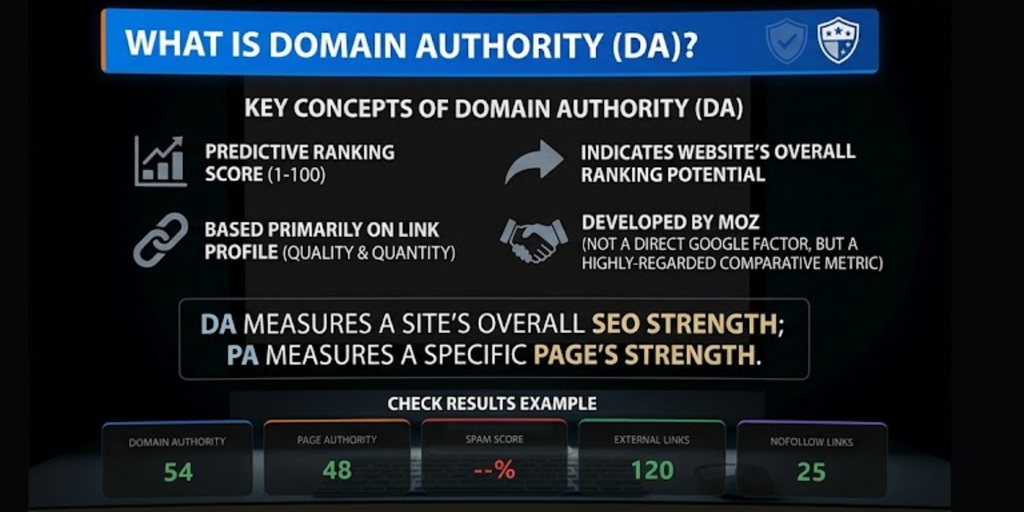
A DA Checker is an SEO analysis tool designed to check the Domain Authority score of a website. Domain Authority is a metric developed by Moz that predicts a website’s potential to rank in search engine results based on multiple factors, including its backlink profile.
The score generally ranges from 1 to 100. A higher score can indicate a stronger backlink profile, but it does not guarantee higher Google rankings. Search engines use many ranking factors, and Domain Authority is not an official Google ranking factor.
Website owners can use a DA Checker to compare domains, monitor SEO progress, and identify areas that may need improvement.
What Is Domain Authority (DA)?
Domain Authority measures the relative ranking strength of an entire domain. It is primarily useful for comparing websites and evaluating their SEO profiles.
A website’s DA score may be influenced by factors such as:
- The quality and relevance of backlinks.
- The number of referring domains.
- The strength of the website’s link profile.
- The overall backlink authority of linking websites.
Domain Authority is not a permanent score. It can change as backlinks are gained or lost and as the underlying calculation or comparison landscape changes.
For better SEO results, focus on earning relevant backlinks, publishing useful content, and maintaining a technically sound website instead of chasing a specific DA score.
What Is Page Authority (PA)?
Page Authority is a metric developed by Moz to estimate the ranking potential of an individual webpage. Unlike Domain Authority, which evaluates an entire domain, Page Authority focuses on a particular URL.
For example, a website may have a moderate DA score while one of its pages has a comparatively strong PA score because that page has earned valuable backlinks.
Checking PA can help SEO professionals compare individual pages, evaluate link-building results, and identify pages that may benefit from improved internal linking or additional quality backlinks.
What Is Spam Score?
Spam Score is a metric associated with Moz that estimates the likelihood that a website may share characteristics with websites identified as spam. It is not a direct Google penalty indicator and should not be treated as proof that a website is harmful.
When using a DA Checker that includes Spam Score, review the result alongside other information, such as backlink relevance, anchor text, referring domains, and website quality.
A single metric should never determine whether you reject a backlink or abandon a domain. A broader SEO assessment provides a more reliable basis for decisions.
Key Features of Our DA Checker
A website authority checker can make routine SEO analysis easier by bringing important metrics together in one place. Depending on the features available in the tool, users may benefit from the following functions.
Domain Authority Analysis
Check the available DA metric to understand the relative authority of your domain. Use the result as a comparison point when reviewing competitors or monitoring long-term SEO development.
Page Authority Checking
Evaluate individual URLs to understand how their backlink profiles compare. This can be helpful when prioritizing important landing pages, articles, and service pages.
Spam Score Review
Review the available Spam Score metric as one part of a wider backlink quality assessment. Investigate suspicious links before making changes to your SEO strategy.
Simple Website Analysis
A straightforward interface makes it easier for beginners and experienced SEO professionals to review website metrics without unnecessary complexity.
SEO Research Support
Use authority metrics during competitor research, domain evaluation, link-building planning, and routine website audits.
How to Use a DA Checker
Checking website authority is generally a simple process. Follow these steps to review your website’s available SEO metrics.
- Open the DA Checker tool on your device.
- Enter the complete website domain or URL in the input field.
- Review the entered address to ensure it is correct.
- Click the Check or Analyze button, depending on the interface.
- Wait for the tool to process the submitted website.
- Review the available DA, PA, Spam Score, or other displayed metrics.
- Save the results if you want to compare them with a future analysis.
The exact results depend on the data source and features supported by the tool. If no result appears, verify the URL and try again later.
Why Is DA Checking Important for SEO?
DA checking can support SEO planning by helping website owners compare their backlink profiles with competing websites. However, authority metrics are most useful when interpreted alongside other performance indicators.
Competitor Analysis
Comparing your domain with relevant competitors can reveal differences in backlink strength and help you identify realistic SEO opportunities. Compare websites targeting similar topics and audiences for more meaningful results.
Backlink Strategy
Authority metrics can support link-building research, but a high DA score alone does not make a website a good backlink source. Relevance, editorial quality, real traffic, and natural link placement also matter.
Website Growth Monitoring
Regular checks can help you observe changes in your domain’s authority metrics over time. Record the date and results of each check because third-party scores may fluctuate.
Content Planning
When reviewing competing pages, combine authority metrics with content quality, search intent, topical coverage, and internal linking. This provides a more complete picture of why a page may perform well.
DA Checker vs. PA Checker
DA and PA measure different aspects of website authority. Understanding the difference helps you select the appropriate metric for your SEO task.
| Feature | DA Checker | PA Checker |
|---|---|---|
| Main purpose | Evaluates domain level authority | Evaluates page level authority |
| Scope | Entire domain | Individual webpage |
| Common use | Competitor domain analysis | Individual page comparison |
| SEO application | Domain and backlink research | Page optimization and link research |
| Ranking guarantee | No | No |
Both metrics are useful for research, but neither guarantees a particular position in Google search results.
How to Improve Your Website’s DA Score
Improving Domain Authority usually requires consistent work on your website’s overall SEO and backlink profile. Since DA is a third-party metric, the following practices should be treated as ways to improve SEO quality rather than guaranteed methods of increasing a score.
Build High Quality Backlinks
Earn backlinks from relevant websites through original research, useful resources, expert contributions, and genuine editorial relationships. Avoid buying manipulative links or participating in link schemes.
Publish Helpful Content
Create original, accurate, and well-organized content that answers users’ questions. Strong content can attract natural references and give visitors a reason to return to your website.
Improve Internal Linking
Connect related pages using descriptive and relevant anchor text. Good internal linking helps users discover additional content and helps search engines understand the relationships between pages.
Fix Technical SEO Issues
Review indexing, crawlability, broken links, redirects, mobile usability, and page performance. A technically accessible website makes it easier for search engines to discover and process your content.
Remove Low Quality SEO Practices
Avoid automated backlink schemes, excessive keyword stuffing, copied content, and manipulative link exchanges. These approaches can damage website quality and create unnecessary SEO risks.
Monitor Progress Consistently
Use your DA Checker at reasonable intervals and record changes over time. Also monitor Google Search Console data, organic clicks, impressions, indexing, and relevant keyword performance.
Common Uses of a Free DA Checker
A free DA Checker can be useful for different website management and digital marketing activities.
- Bloggers can compare their websites with relevant publications.
- SEO professionals can evaluate domains during competitor research.
- Digital marketers can review backlink prospects before outreach.
- Website owners can monitor changes in authority metrics.
- Content publishers can compare the relative strength of individual pages.
- Domain buyers can use authority metrics as one part of their preliminary research.
Before purchasing an expired or existing domain, also investigate its historical content, backlink sources, indexing status, previous use, and potential trademark issues. A strong authority score alone does not establish that a domain is valuable or safe to purchase.
Limitations of Domain Authority Checking
Although DA Checkers are useful for SEO research, their results have limitations. Different tools may use different data sources, calculations, or update schedules, so scores may not match across platforms.
Furthermore, Domain Authority is not a Google metric. A website with a high DA score can rank poorly for a particular keyword, while a lower-authority website can rank well when its content better satisfies search intent.
For this reason, use DA, PA, and Spam Score as supporting indicators rather than final measures of SEO success. Actual search performance should be evaluated using relevant search data, content quality, technical health, and user needs.
Who Should Use a DA Checker?
A DA Checker is suitable for bloggers, website administrators, SEO agencies, freelance marketers, content publishers, and digital businesses that want to understand website authority metrics.
Beginners can use it to learn about backlink profiles, while experienced professionals can incorporate its results into broader competitor research and SEO audits. No advanced SEO knowledge is necessary to start reviewing basic authority metrics, although interpreting them correctly requires an understanding of their limitations.
Frequently Asked Questions
Q. What is a DA Checker?
A DA Checker is an SEO tool used to check the Domain Authority score of a website and support domain comparison.
Q. Is Domain Authority a Google ranking factor?
No. Domain Authority is a third-party metric developed by Moz and is not an official Google ranking factor.
Q. What is a good DA score?
There is no universally good DA score. Compare your website with relevant competitors in the same niche rather than relying on a fixed target.
Q. Can I check Page Authority with a DA Checker?
Yes, if the selected tool supports PA checking alongside Domain Authority analysis.
Q. Does a higher DA guarantee better rankings?
No. Search rankings depend on many factors, including content relevance, search intent, technical SEO, competition, and the quality of a website’s overall SEO.
Conclusion
A DA Checker is a practical tool for reviewing Domain Authority and supporting website SEO research. When available, PA and Spam Score can provide additional context for evaluating individual pages and backlink profiles.
For the best results, combine authority metrics with helpful content, relevant backlinks, technical SEO improvements, and regular performance monitoring. Treat every score as an estimate rather than a guarantee, and focus on building a trustworthy website that provides genuine value to its visitors.